Note: TurboQuant-Adam is an applied research extension of TurboQuant (Zandieh et al., ICLR 2026) from Google Research, Google DeepMind, and NYU. This is an independent effort by YATAV Research Lab — not affiliated with the original authors. See the technical report for full attribution and the open-source repository (Apache 2.0) for implementation.
Executive Summary
TurboQuant's 4-bit momentum compression (8× communication reduction) and activation compression (4× memory savings) directly impact the two largest cost variables in LLM distributed training.
| Impact Dimension | Current Bottleneck | TurboQuant Effect | Business Impact |
|---|---|---|---|
| Network Cost | Communication = 20–55% of training time | 8× traffic reduction | Ethernet replaces InfiniBand |
| GPU Memory | Activations = 40–60% of VRAM | 4× activation compression | Larger batches, fewer GPUs |
| Infrastructure | InfiniBand mandatory (2× cost) | Ethernet sufficient | $8M savings per 1,000-GPU cluster |
| Scalability | Communication bottleneck at scale | Bottleneck eliminated | Near-linear GPU scaling |
Projected savings: 1.2M per 70B training run (20–40% of total cost) and $8M infrastructure savings per 1,000-GPU cluster deployment.
Current State: GPU Training Cost Structure
GPU Cloud Pricing (March 2026)
| GPU | Major Cloud | Specialized Cloud | Spot (Lowest) |
|---|---|---|---|
| H100 SXM5 | 12.29/hr | 3.44/hr | $0.99/hr |
| A100 80GB | 5.78/hr | 2.06/hr | $0.74/hr |
LLM Training Cost by Scale
| Model Scale | Estimated Cost | GPU Configuration | Duration |
|---|---|---|---|
| 7B | 500K | 64× H100 | 2–4 weeks |
| 70B | 6M | 256× H100 | 3–8 weeks |
| 175B (GPT-3 class) | 4.6M | 1,000–2,000× H100 | 2–4 months |
| Frontier (GPT-4 class) | 120M+ | 2,000+× H200 | 2–4 months |
Impact Analysis
Impact 1: Communication — Enabling the InfiniBand-to-Ethernet Transition
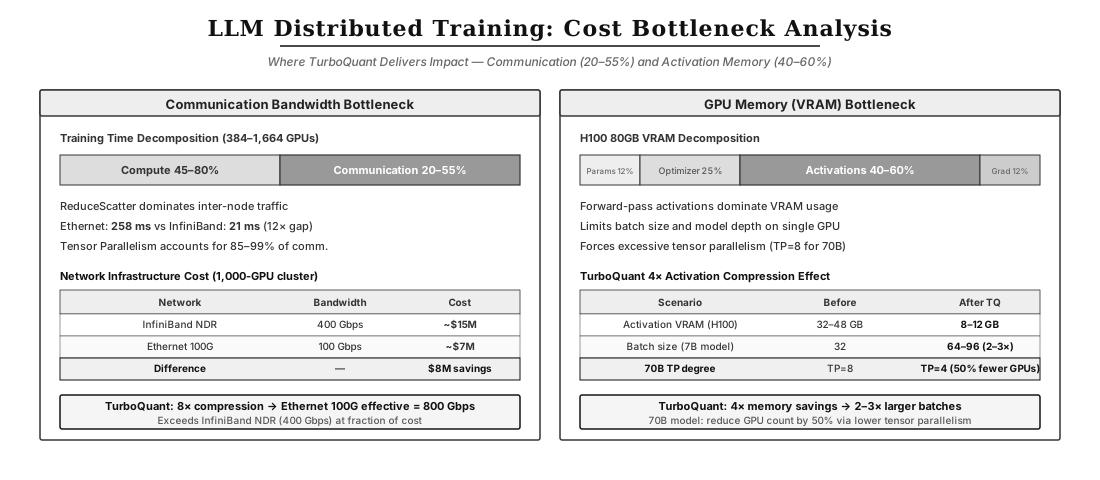
8× communication reduction transforms the effective bandwidth equation.
| Network | Physical BW | With TQ (Effective) | Comparison |
|---|---|---|---|
| InfiniBand NDR | 400 Gbps | 3,200 Gbps (eff.) | Over-provisioned |
| Ethernet 100G | 100 Gbps | 800 Gbps (eff.) | 2× InfiniBand NDR |
| Ethernet 25G | 25 Gbps | 200 Gbps (eff.) | ≈ InfiniBand HDR level |
Key insight: With TurboQuant, a 15M InfiniBand deployment — saving $8M per 1,000-GPU cluster.
This aligns with the industry trend exemplified by Meta's selection of RoCE Ethernet for 24,000-GPU Llama 3 training. TurboQuant makes this transition viable for a much broader range of organizations.
Impact 2: Infrastructure Architecture Transformation
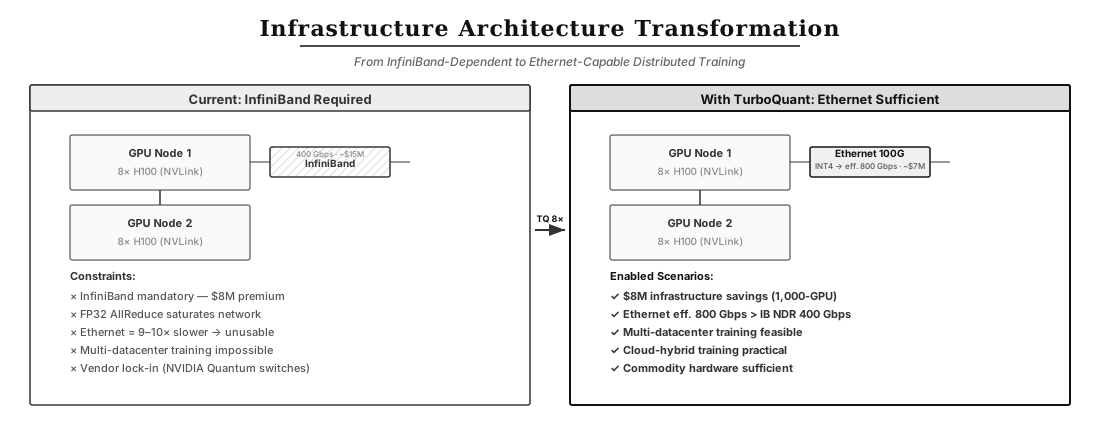
TurboQuant unlocks previously impossible deployment scenarios.
| Scenario | Current | With TurboQuant |
|---|---|---|
| Multi-datacenter training | Impossible (bandwidth) | Feasible (8× compression) |
| Cloud-hybrid training | Impractical | Practical |
| Low-cost GPU pool utilization | Inefficient without IB | Ethernet sufficient |
| Edge-cloud federated training | Impossible | Under consideration |
Impact 3: Direct Training Cost Reduction
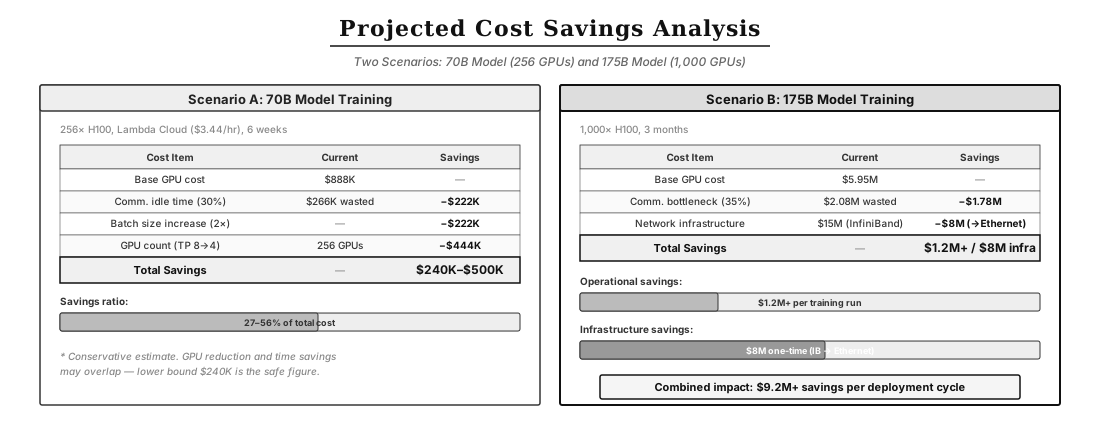
Impact 4: GPU Memory Efficiency
4× activation compression has cascading effects on hardware utilization.
| Model | Current (H100) | With TQ (H100) | Effect |
|---|---|---|---|
| 7B | batch=32 | batch=64–96 | Training time −20–30% |
| 13B | batch=16 | batch=32–48 | GPU utilization ↑ |
| 70B | batch=1–2 (TP=8) | batch=4–8 (TP=4) | GPU count −50% |
For 70B models, activation compression enables reducing tensor parallelism from TP=8 to TP=4, cutting required GPU count by half.
Competitive Positioning
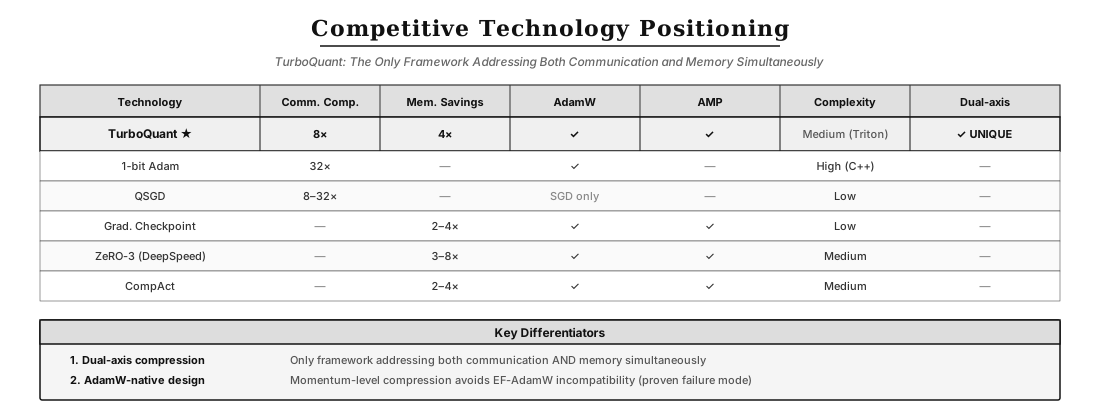
TurboQuant은 다음과 같은 차별점을 갖는다.
- Dual-axis compression — only framework addressing both communication AND memory simultaneously
- AdamW-native design — momentum-level compression avoids the proven EF–AdamW failure mode
- AMP compatible — validated with PyTorch Automatic Mixed Precision for production readiness
Industry Impact
Cloud Service Providers (AWS, GCP, Azure)
- New GPU instance tiers: Low-cost training instances without InfiniBand premium
- Price competitiveness: Ethernet-based GPU clusters at 30–50% lower cost
- Utilization: Memory efficiency increases GPU throughput per customer
AI Startups & Research Institutions
- Barrier reduction: Large-scale training feasible on commodity Ethernet infrastructure
- Cost efficiency: 70B training cost from 600K–$800K
- Experiment velocity: Same budget enables 2–3× more training runs
On-Premises Operators
- Network CAPEX: InfiniBand → Ethernet saves $8M per 1,000-GPU cluster
- Legacy reuse: Existing Ethernet infrastructure becomes LLM-training capable
- Power: InfiniBand switch elimination reduces power consumption 15–20%
Risk Assessment
Technical Risks
| Risk | Severity | Mitigation |
|---|---|---|
| 7B+ scale unvalidated | High | Staged scale-up experiments planned |
| Speed overhead (2–4×) | Medium | C++/CUDA native kernel optimization |
| Long-run stability (100K+ steps) | Medium | Incremental training duration experiments |
| FSDP/Megatron-LM incompatibility | Medium | Framework integration development |
Commercialization Roadmap
Phase 1: Near-term (3 months)
- C++/CUDA kernel optimization → overhead ≤1.2×
- LLaMA 7B validation → practical scale proof-of-concept
- PyPI package release:
pip install turboquant
Phase 2: Mid-term (6 months)
- DeepSpeed/Megatron-LM integration → enterprise adoption path
- 8× H100 multi-node benchmark → marketing-ready speedup data
- 13B–70B validation → core customer segment proof
Phase 3: Long-term (12 months)
- Cloud service integration (SageMaker, Vertex AI) → one-click deployment
- Ethernet-only training cluster proof-of-concept → infrastructure cost revolution
- Frontier model (175B+) validation → market leadership position
Conclusion
TurboQuant has the potential to fundamentally reshape the cost structure of LLM distributed training.
20–55%의 통신 오버헤드를 8× 압축으로, 40–60%의 VRAM 병목을 4× 활성화 절감으로 해소함으로써 다음과 같은 효과가 달성된다.
- $8M infrastructure savings — InfiniBand → Ethernet transition per 1,000-GPU cluster
- 27–56% training cost reduction — 500K per 70B model training run
- 2–3× larger batches on identical hardware → improved throughput
- 50% GPU reduction possible for 70B models via lower tensor parallelism
- New architectures enabled — multi-datacenter, cloud-hybrid, and edge-cloud training
| Dimension | Assessment |
|---|---|
| Technical Viability | Validated (355M, 1,500 steps, loss gap < 0.003) |
| Business Impact | High (multi-million dollar savings potential) |
| Time to Market | 3–6 months (C++ optimization + 7B validation) |
| Market Timing | Aligned (Ethernet transition trend) |
| Competitive Position | Differentiated (unique dual-axis compression) |
This analysis is based on March 2026 market data and TurboQuant experimental results. Actual cost savings will vary depending on specific model, infrastructure, and cloud configurations.
References
The technical results cited in this whitepaper are drawn from the companion technical report AEGIS-TR-2026-004 and the open-source implementation. 주요 기반 참고문헌은 아래와 같다.
- A. Zandieh (Google Research), M. Daliri (NYU), M. Hadian (Google DeepMind), V. Mirrokni (Google Research), "TurboQuant: Online Vector Quantization with Near-optimal Distortion Rate," ICLR, 2026. arXiv:2504.19874 — foundational quantization framework for distributed inference; our starting point
- H. Tang et al., "1-bit Adam: Communication Efficient Large-Scale Training," ICML, 2021 — momentum compression strategy
- Communication bottleneck data: arXiv:2512.24750 (384–1,664 GPU benchmarks, Gemma 3 12B)
- GPU cloud pricing: Lambda Cloud, RunPod, AWS, GCP, Azure — March 2026 rates
- Meta Llama 3 training infrastructure: RoCE Ethernet deployment at 24,000 GPU scale
Acknowledgments
본 백서는 소규모 스타트업인 YATAV Inc.의 연구 조직 AEGIS Research에서 수행한 소규모 프로젝트의 산출물이다. 대규모 기업의 인프라나 전담 경제 분석팀 없이, 공개된 기술 데이터와 클라우드 가격 정보를 기반으로 독립적인 비즈니스 영향 분석을 시도하였다.
본 분석의 기술적 토대가 된 TurboQuant-Adam 연구 프레임워크는 Amir Zandieh(Google Research), Majid Daliri(New York University), Majid Hadian(Google DeepMind), Vahab Mirrokni(Google Research)의 TurboQuant(ICLR 2026) 위에 구축되었다. 그들이 연구를 공개적으로 접근 가능하게 한 결정이 추론에서 학습으로의 응용 확장을 가능하게 하였으며, 우리와 같은 소규모 팀이 이를 경제적 관점에서 분석할 기회를 제공하였다. 또한 Hanlin Tang et al.(1-bit Adam, ICML 2021)의 모멘텀 압축 전략이 TurboQuantAdamW 설계에 직접적 영감을 주었음에 감사드린다. 본문에서 인용된 통신 병목 측정 데이터는 분산 학습 커뮤니티의 대규모 GPU 클러스터 벤치마크에서 인용하였다. 비용 예측은 공개 클라우드 가격에 기반한 추정치이며, 실제 절감액은 특정 배포 구성에 따라 달라질 것이다.
Disclaimer
본 백서는 YATAV Inc. 산하 AEGIS Research의 독립적 분석이다. 원 TurboQuant 저자, Google Research, Google DeepMind, 뉴욕대학교와 제휴, 보증, 공식적 연관이 없다. 모든 비용 예측은 추정치이며, 인프라 투자 결정 전에 특정 배포 구성에 대해 검증되어야 한다.